
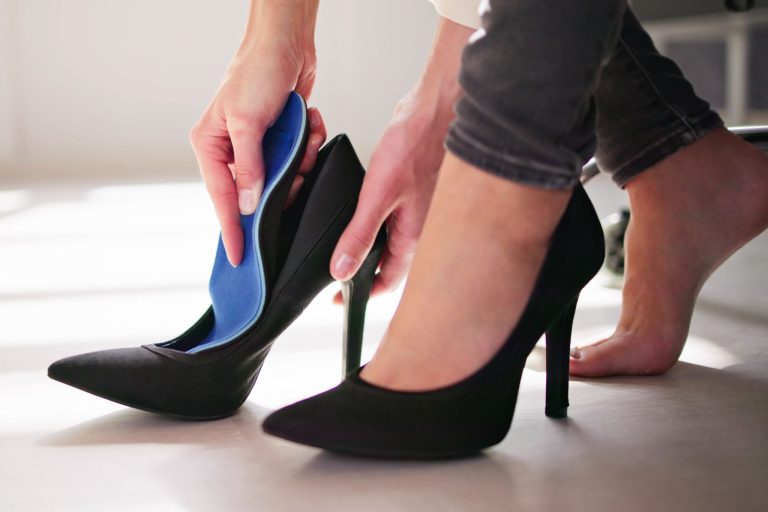
Many women suffer from foot pain caused by wearing high-heeled shoes. Between bunions on the feet, postural problems and many other podiatric conditions, many women are trying to combine lifestyle and good foot health. The podiatric solution: foot orthotics. To find out more, we spoke to Dr. Marie-Michelle Gravel, a podiatrist at the University of Ottawa.Marie-Michelle Gravel, podiatrist. With her advice, many women will find the right balance between wearing high-heeled shoes and foot orthotics.
Can injuries caused by wearing high heels be chronic?
Of all the injuries caused by wearing high heels, it is the bone or muscle deformities that can be described as chronic.
Apart from these, I distinguish three types of injury linked to high heels: injuries that heal on their own, those that regenerate slowly, and those where the damage is permanent.
For example, some Achilles tendon strains can take longer to heal. However, an injury that heals slowly is not necessarily permanent or chronic.
Are some women more at risk than others of experiencing pain when wearing high heels?
Yes, of course, the way in which high heels affect the mechanics of the foot varies from one woman to another. Even though we all have the same basic musculature and bone structure, it’s always case by case.
The symptoms caused by wearing high heels therefore manifest themselves in completely different ways from one person to another. For example, two women may come to my clinic wearing the same pair of shoes: one will feel severe pain behind the heel, while the other will experience no discomfort at all.
What podiatric factors influence the pain experienced by a woman wearing a high heel?
The type of shoes worn is a factor that can influence the intensity of foot pain. For example, some women opt for shoes with very high heels, which does nothing to help heel or back pain. Others prefer shoes with wedges. While these are not beneficial, they are generally less harmful to foot mechanics.
There is also the frequency with which the shoe is worn. If a patient wears high heels occasionally, she is less likely to develop problems than a woman who wears them every day.
What is the biggest myth about wearing high heels?
The myth I hear most often is that wearing high heels automatically leads to the development of bunions.
This may be true, of course, but it’s not automatic. As I explained above, it depends on a number of factors (lifestyle, type of shoes, frequency of wearing high heels, the patient’s podiatric history, etc.). I’ve met patients who’ve worn this type of shoe all their lives without experiencing the slightest problem.
In your opinion, are women aware of the possible consequences of wearing high heels?
Unfortunately not. Most of my patients are unaware of the extent of the damage that can result from wearing this type of shoe.
For example, many suffer from ingrown toenails, postural problems, pain behind the heel, plantar fasciitis, bone conditions, and so on! The unfortunate thing is that they don’t know that these symptoms are directly caused by the way they wear their shoes.
What benefits can orthotics bring?
Obviously, one of the first benefits of orthoses is to relieve the symptoms caused by wearing high heels. In some cases, orthoses can even help prevent problems such as sprained ankles.
What’s more, orthotic treatment really comes into its own when the orthotic is custom-fitted by a podiatrist. Whatever the problem, the orthosis guides the movement of the woman’s foot without requiring her to change her lifestyle.
Can an orthotic prevent certain pain or podiatric conditions in women who wear high heels?
Yes, in some cases it can. However, I’d like to stress that it doesn’t completely prevent podiatric problems. Of course, it can help, but it’s by no means a guarantee against problems. I’d also like to point out that it can’t correct more serious problems, such as bone deformity, for example.
Are there several types of orthotic designed to relieve the pain associated with wearing high heels?
Yes, orthotic manufacturers offer a fairly wide range of products. As they are very familiar with patients’ needs, they offer catalogues with models that vary according to the mechanics of the foot, the environment in which the patient lives, etc. Women who wear this type of shoe can therefore benefit from plantar orthoses that are shorter or have thinner plastic.
How do Cryos orthotics differ from other orthotics on the market for women who wear high heels?
What gives them a head start is the fact that they are dynamic. These are not orthoses that will obstruct the movement of the foot: they guide the foot for better movement.What’s more, thanks to their small, discreet shape, they can be fitted over all types of footwear (sandals, flat shoes, high heels, etc.), so patients can wear them more often. In my opinion, the Cryos foot orthosis makes this type of podiatric treatment both more versatile and more accessible for women.